













 ਬਲੌਗ ਤੇ ਵਾਪਸ ਜਾਓ
Desert-Climate Dairy: Cattle Feed Guide for Northern Rajasthan
Northern Rajasthan is not the first place most people associate with thriving dairy farming. Yet the districts of Hanumangarh and Sri Ganganagar, sitting right on the Punjab and Haryana border, have quietly built one of the most resilient dairy economies in the Thar Desert fringe. The reason is simple: the Indira Gandhi Canal. Since its waters reached these arid lands, thousands of farming families have diversified into dairying, and today Hanumangarh alone houses over four lakh milch animals.
The Indira Gandhi Canal Transformation
Before the canal, livestock in northern Rajasthan survived on sparse grazing and seasonal crops. Farmers kept hardy Rathi cattle and local goats, primarily for draught and subsistence milk. The canal changed everything. With reliable irrigation came berseem, lucerne, and sorghum cultivation, giving farmers year-round green fodder for the first time. Progressive farmers imported Murrah buffaloes from neighbouring Hisar and Sirsa, and crossbred cows began appearing in villages that had never seen a Holstein. Today, daily milk collection in Hanumangarh district exceeds three lakh litres, with Saras dairy and private processors competing for supply.
Breed Selection for Desert Conditions
The Rathi breed remains the intelligent choice for farmers who cannot invest in full cooling infrastructure. Rathi cows tolerate ambient temperatures above 45°C far better than crossbreds, maintain reasonable feed intake during heat waves, and produce 8 to 12 litres per day on balanced nutrition. For farmers with pucca sheds and fans, Murrah buffaloes yielding 10 to 14 litres of high-fat milk offer better per-litre returns at the milk chilling centre. The key is matching breed choice to the infrastructure you can actually maintain through May and June.
Heat-Resilient Feeding Strategies
When afternoon temperatures cross 45°C, cattle voluntarily reduce dry matter intake by 15 to 25 percent. Fighting this drop requires restructuring the entire feeding schedule. Offer the morning concentrate ration before 6:00 AM, when animals are still willing to eat aggressively. The second concentrate meal should come after 7:30 PM, once ambient temperature falls below 38°C. Between these two windows, provide ad libitum access to good quality dry roughage and fresh water.
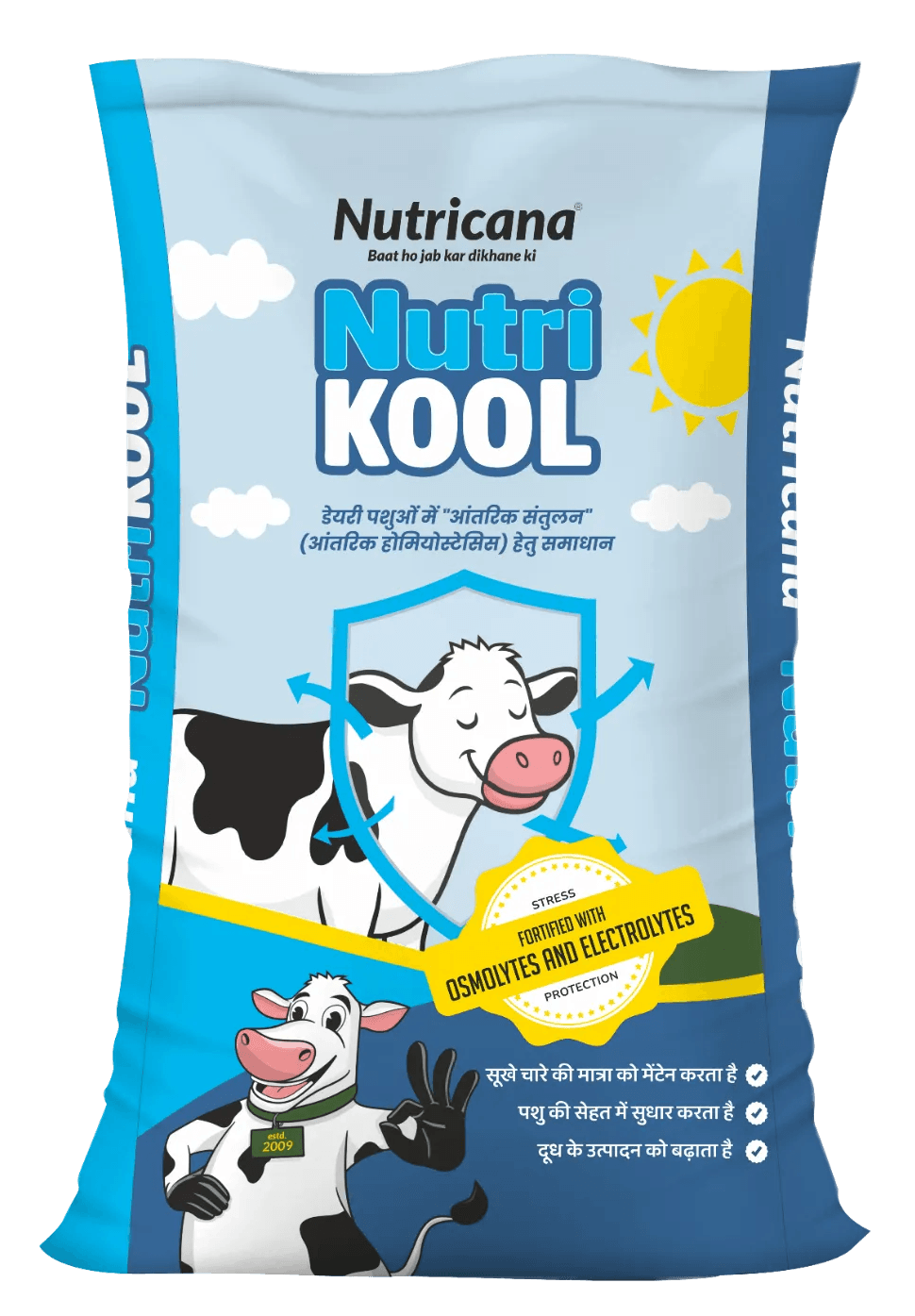
Energy density of the concentrate must increase during summer. Replace 10 to 15 percent of cereal grain with bypass fat at 150 to 200 grams per day to compensate for the intake drop without overloading the rumen. Nutricana's NutriKOOL heat stress supplement, added at 50 grams per day, supplies betaine, niacin, and buffered electrolytes that help cattle maintain rumen pH and peripheral blood flow during thermal load. Farmers in Hanumangarh who adopted NutriKOOL in the 2025 summer reported holding milk yield within 8 percent of their spring peak, compared to the usual 20 percent crash.
Water Scarcity Management
Even with the canal, water availability is not unlimited. A lactating Murrah buffalo needs 80 to 100 litres of drinking water daily in peak summer, and many farms struggle to provide this. Install shaded water troughs that keep temperature below 25°C — cattle drink significantly more when water is cool. Recycle shed wash-water for fodder irrigation rather than letting it drain. Every litre saved on the field side means a litre more in the trough.
Shade and Cooling on a Budget
A simple thatched roof (sirki) over the resting area drops radiant heat load by 8 to 10°C compared to open sky. Adding a single ceiling fan per four animals costs roughly ₹2,500 in installation and under ₹200 per month in electricity but can recover 1.5 to 2 litres of milk per animal per day during peak heat. For larger herds, fogger systems installed along the feed manger line at ₹12,000 to ₹15,000 provide evaporative cooling that buffaloes respond to dramatically.
Economics: Dairy vs Crop Farming in Arid Climate
A five-buffalo unit producing 50 litres daily at ₹55 per litre generates ₹82,500 monthly revenue. After feed costs of approximately ₹40,000 (using 30 kg green fodder, 6 kg Nutricana compound feed, and 4 kg wheat straw per buffalo per day), labour, and miscellaneous expenses, net monthly income ranges from ₹25,000 to ₹35,000. Compare this with rain-dependent guar or bajra farming on 10 bigha, which yields seasonal income of ₹40,000 to ₹60,000 — but only once or twice a year. Dairy provides twelve months of steady cash flow, a crucial advantage in desert districts.
Nutricana Dealer Access
Hanumangarh's proximity to Punjab dairy infrastructure means Nutricana's dealer network extends comfortably into the district. Feed is available through authorised distributors in Hanumangarh town, Nohar, and Bhadra, with weekly delivery runs reaching most canal-side villages. Farmers can consult Nutricana's field nutritionists for customised ration planning suited to their herd size and breed composition.
Nutricana Feed Team
Editorial Team
The Nutricana Feed Team combines veterinary science, dairy farming expertise, and nutritional research to bring practical, evidence-based guidance to Indian dairy farmers.


