
 ਬਲੌਗ ਤੇ ਵਾਪਸ ਜਾਓ
Summer Heat Stress Solutions: State-by-State Guide for North Indian Dairy Farmers
Heat stress kills more dairy profit than any disease in North India. Between April and June, temperatures across the Indo-Gangetic plain push cattle beyond their thermoneutral zone for 10 to 14 hours every day. The result is a nationwide milk production trough that costs the industry an estimated ₹25,000 crore annually. Understanding how heat affects your specific region — and your specific breed — is the first step toward keeping those losses off your balance sheet.
The Temperature-Humidity Index Explained
The Temperature-Humidity Index (THI) combines air temperature and relative humidity into a single number that predicts cattle comfort. Below THI 72, cattle are comfortable. Between 72 and 79, mild stress begins — expect a 5 to 10 percent yield drop. Between 80 and 89, moderate stress causes 10 to 20 percent production loss and visibly distressed behaviour. Above 90, cattle are in severe stress with risk of mortality. The critical insight is that humidity amplifies heat: a dry 42°C day in Rajasthan (THI 82) may actually be less stressful than a humid 38°C day in Bihar (THI 86).
State-by-State Peak Temperatures
Rajasthan leads with peak temperatures of 46 to 48°C in Barmer, Jaisalmer, and Churu, though dairy districts like Hanumangarh and Sri Ganganagar experience 44 to 46°C with lower humidity. Uttar Pradesh and Bihar hit 42 to 44°C but with devastating humidity that pushes THI above 90 in eastern districts like Gorakhpur, Deoria, Varanasi, and Patna. Punjab and Haryana record 43 to 45°C with moderate humidity — severe but manageable with infrastructure. Himachal Pradesh and Uttarakhand vary dramatically: hill stations above 1,500 metres rarely exceed 32 to 35°C, but the Doon Valley and Una district reach 42°C. Jammu division hits 38 to 42°C while the Kashmir Valley stays relatively mild at 30 to 35°C.
Breed-Specific Heat Tolerance
Buffaloes are more vulnerable to heat stress than crossbred cows because their dark skin absorbs more radiant heat and they have fewer sweat glands per unit of body surface. A Murrah buffalo shows stress signs at THI 74, while a crossbred Holstein-Sahiwal cow tolerates up to THI 78 before production drops. Indigenous breeds like Sahiwal, Tharparkar, and Rathi possess superior heat tolerance, maintaining feed intake at temperatures where crossbreds shut down. In severe heat zones, indigenous genetics crossed with moderate-yielding exotics often deliver better annualised production than high-genetic-merit Holsteins that crash every summer.
Cooling Strategies by Budget
At the entry level, ceiling or pedestal fans at ₹2,000 to ₹3,000 per unit move air across the animal's body and increase evaporative cooling from the skin. Place fans to create a breeze of 6 to 8 kilometres per hour at animal level. At mid-budget, fogger systems installed along feed mangers cost ₹12,000 to ₹15,000 per 10-metre line and combine air movement with fine water mist that drops ambient temperature by 5 to 8°C in the immediate zone. Full cooling — tunnel-ventilated sheds with automated sprinklers and exhaust fans — costs ₹40,000 to ₹60,000 per animal space but pays for itself within two lactations for herds averaging 25 litres or more.
Feeding Adjustments for Heat
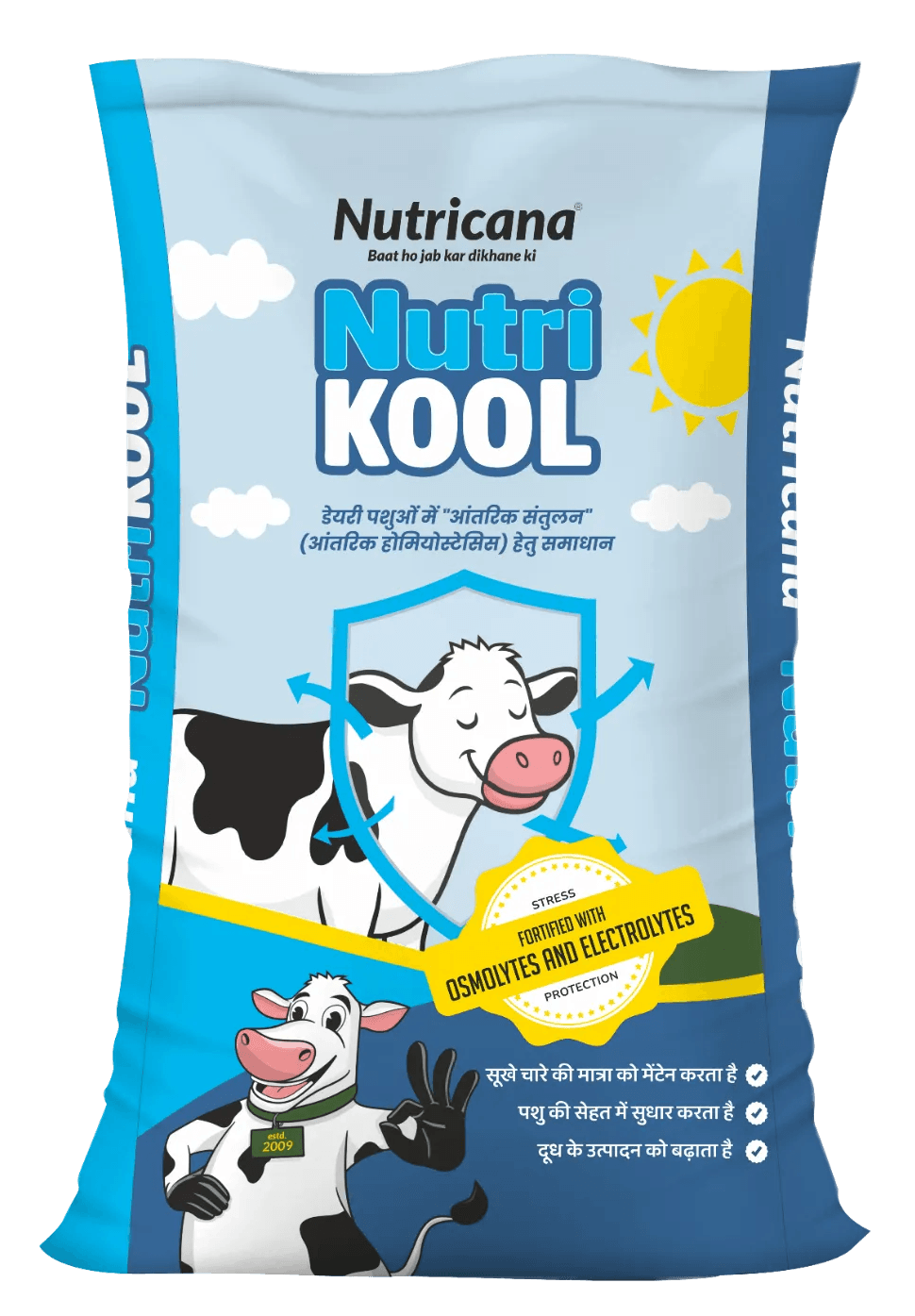
When cattle eat less, every kilogram of feed must deliver more. Increase the energy density of the concentrate by adding 2 to 3 percent bypass fat. Reduce crude fibre from 14 to 10 percent to lower metabolic heat generated during fibre digestion. Add electrolytes — potassium chloride at 80 grams and sodium bicarbonate at 100 grams per day for a 500 kg cow — to replace minerals lost through excessive sweating and panting. Nutricana's NutriKOOL supplement packages these adjustments into a convenient 50-gram daily top-dress that integrates with any base feed.
Water Intake Targets by Temperature
At 25°C, a cow producing 20 litres of milk needs about 80 litres of water. At 35°C, this rises to 100 litres. At 42°C and above, water demand exceeds 120 litres per day. Provide water through shaded troughs that keep temperature below 22°C — cattle refuse warm water even when dehydrated. Check trough flow rate: a cow drinks 15 to 20 litres per visit in under 3 minutes, so troughs must refill faster than they drain.
Night Feeding Advantages
Shifting 60 percent of the daily concentrate to the 8:00 PM to 5:00 AM window exploits cooler nighttime temperatures for feed digestion. The metabolic heat generated by rumen fermentation peaks 4 to 6 hours after eating. By timing the heaviest meal at night, this heat peak falls during the coolest hours rather than compounding daytime thermal load. Farmers in Ludhiana, Patiala, and Karnal who adopted night feeding during the 2025 summer reported sustaining 90 percent of spring peak yield even through the June heat wave.
Nutricana Feed Team
Editorial Team
The Nutricana Feed Team combines veterinary science, dairy farming expertise, and nutritional research to bring practical, evidence-based guidance to Indian dairy farmers.


